An Eclipse You Walk Through
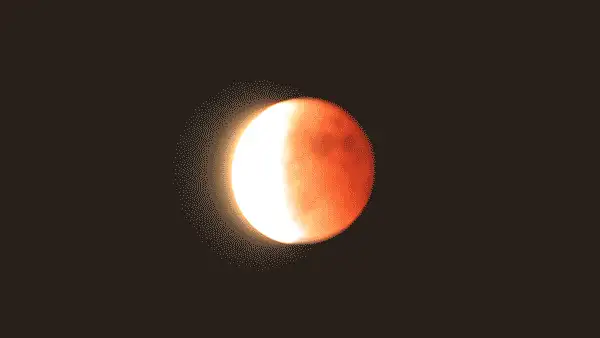
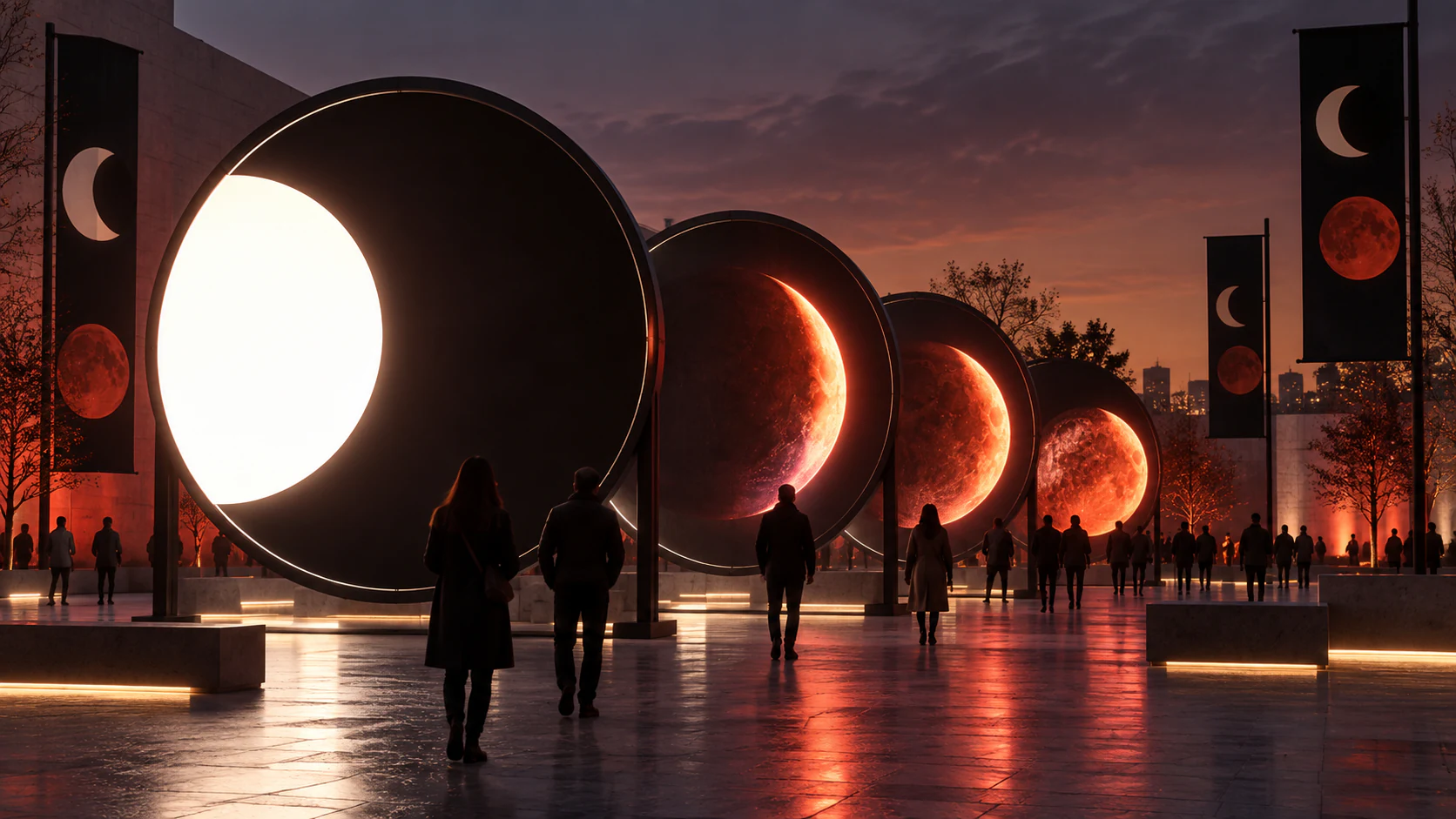
The original eclipse graphic already contains time: concealment, edge and return. This independent public installation converts those phases into a sequence people can walk through. Layered circular screens reveal different relationships between white light, black obstruction and red lunar surface as the viewpoint changes. The work never reproduces an astronomical event literally. Instead, it uses parallax to make perception part of the image. At a distance the discs form a procession; nearby they become thresholds of light and shadow. The plaza turns looking into movement. An eclipse is compelling not because the sun disappears, but because a familiar source of certainty briefly changes its rules.
Borrowed Light
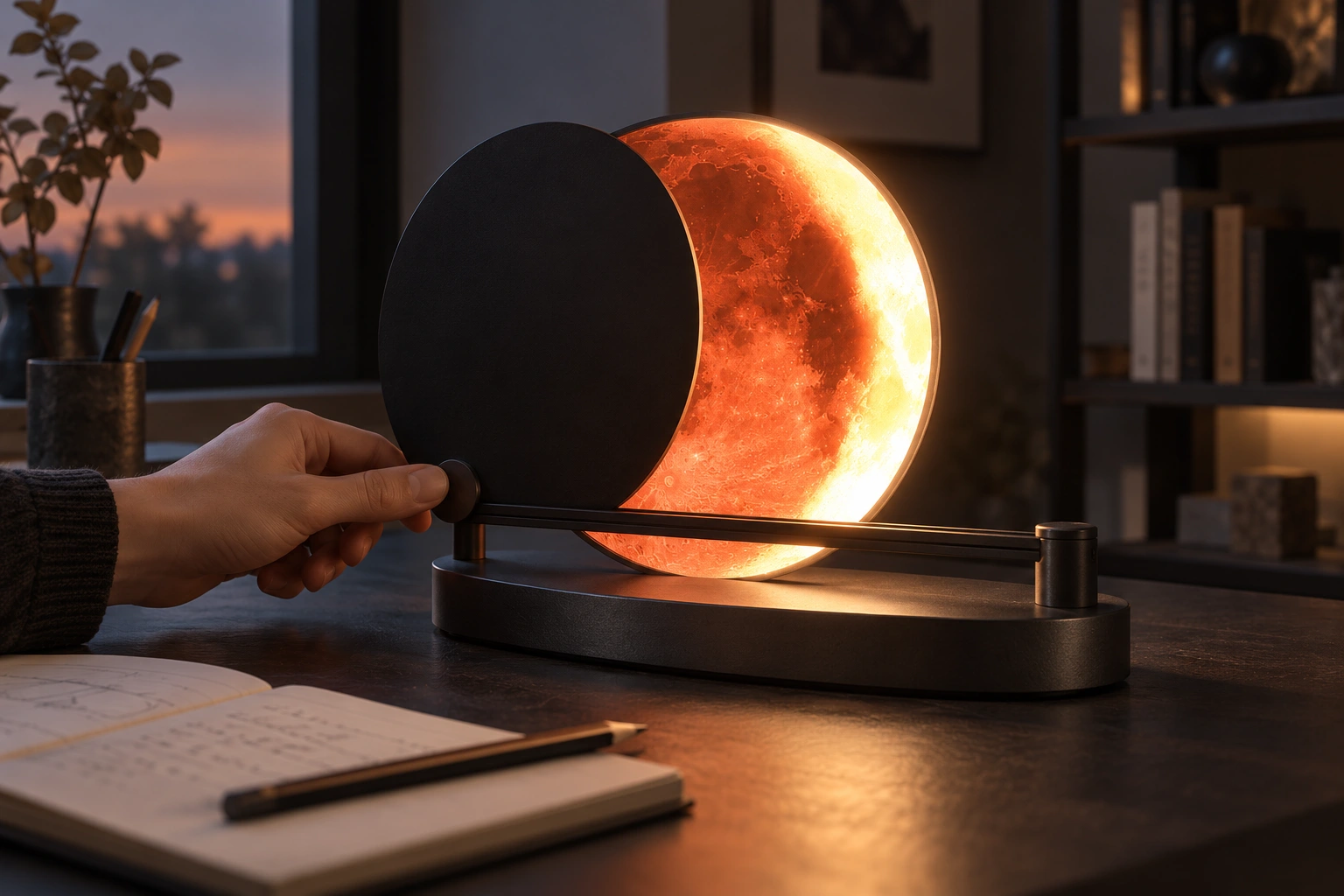
The earlier extension made the eclipse a place to walk through. This independent Studio Extension makes it something to adjust with one hand: a red textured light disc, an opaque travelling shutter and a low, steady base. A small movement changes the image without changing the object. The scene is an unbuilt desk-object proposal; the interactive study below tests its visual rule, not an astronomical event or a manufactured mechanism.
Keep the edge, not just the circle
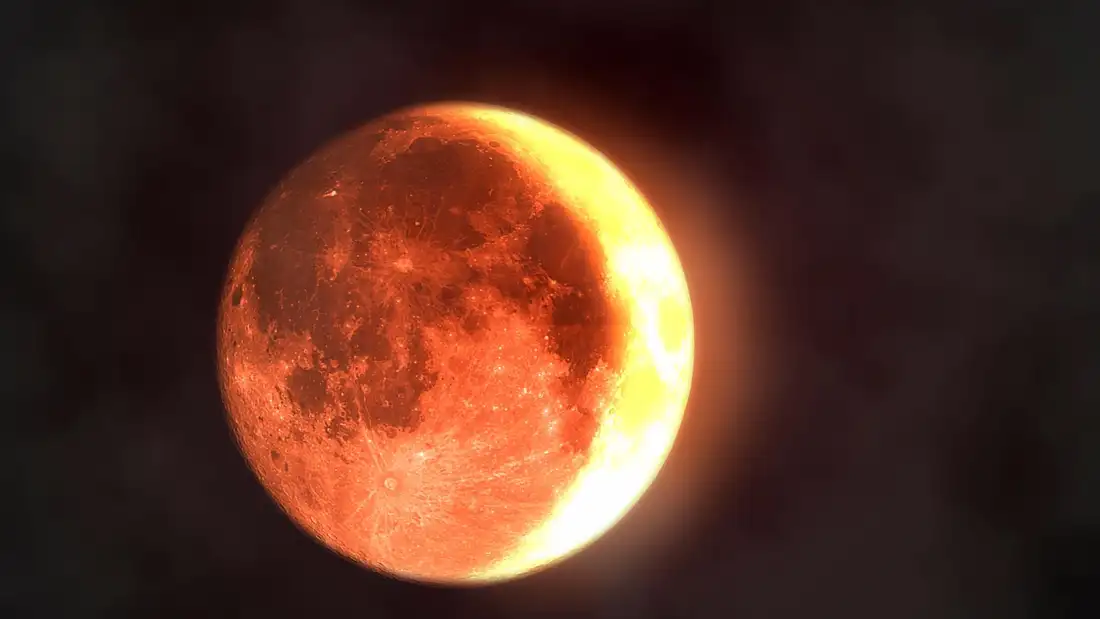
The 2014 source combines a dark field, a red lunar texture, a bright warm rim and changing visibility. Those relationships matter more than putting a moon on another product. The new scene retains the red surface and pale luminous edge while giving the dark occlusion a physical plane. The historical project title is retained for continuity; neither this object nor its simplified interaction is presented as a scientifically accurate solar- or lunar-eclipse simulation.
From public spectacle to private attention
The intended setting is an adult's desk or reading shelf. There is no alarm, score or productivity promise: the object offers a short, deliberate adjustment of light and silhouette. A roughly 180 mm disc is an initial scale target, not a dimensioned drawing. The image conveys material and interaction intent; apparent dimensions and the exact lit area must be tested in a physical study.
Two planes and one constrained movement
The luminous disc stays fixed. A separate black shutter moves laterally in a captured rail, with a lower thumb tab keeping the grip away from the light surface. A broad base and end stops would constrain the travel; a removable rear cover would provide service access. The render suggests this architecture but does not resolve bearings, fasteners, cable routing or pinch clearance. No CAD, printable model or functioning hardware is supplied.
Material should make the rule legible
A matte graphite shutter gives a clean silhouette rather than a mirror reflection. An opal diffuser softens the light, while a replaceable red textured insert carries the source's lunar character. The bright edge should come from controlled light distribution, not an exposed hot ring. Candidate materials and light sources require temperature, glare, impact and cleaning tests. The scene's crater-like texture is an interpretation, not a surveyed lunar map.
Motion is the subtraction
The browser study uses two equal circles: one red field, one opaque disc. Moving the shutter reveals more or less of the field; the displayed percentage describes slider travel, not visible area or an eclipse measurement. Playback follows a slow eased return over twelve seconds. It starts paused, stops when dragged or when the page is hidden, and pauses if the reduced-motion preference changes. The diagram is deliberately simplified: it demonstrates composition, not optical performance or mechanical validation.
Build the awkward parts first
Start with unlit card discs and a rail mock-up. Check one-handed grip, removal resistance, tipping, trapped fingers and end-stop behaviour before adding light. Then test diffusion, surface temperature, dimming, glare at seated eye level and access for repair with a qualified electrical/product specialist. The desk piece is not an aid for viewing the sun. The next milestone is a low-risk physical mock-up, not a louder claim. Darkness has a useful job here; it does not need a feature list.