

Order Is a Temporary Agreement
Design thinking rarely moves in a straight line, despite what the final PDF may imply. This independent extension stages the messy middle as a physical field in which fragments gradually find hierarchy, rhythm and purpose. The final order remains visibly provisional because useful systems should leave room for the next question.

Shift the Horizon
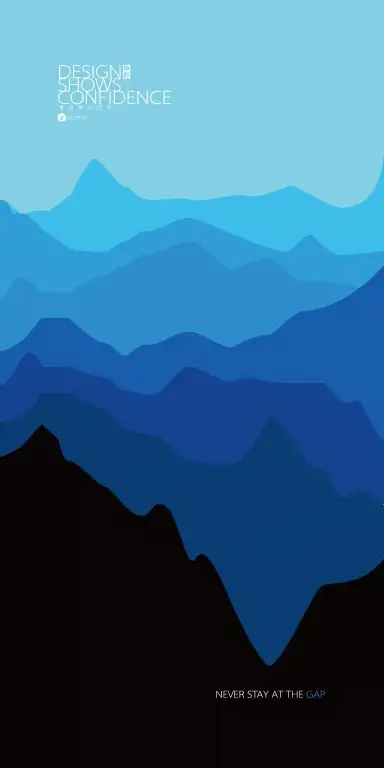
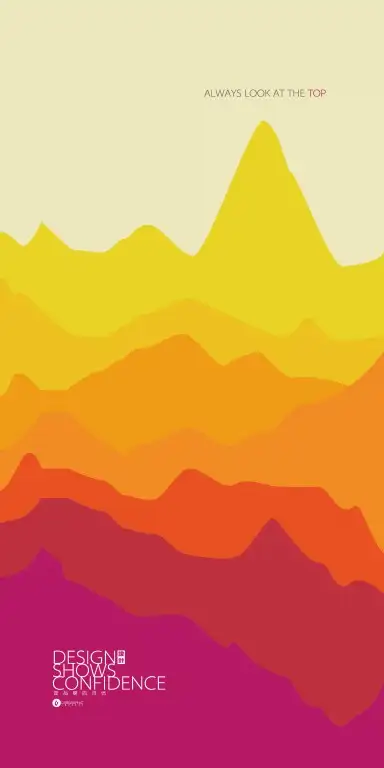
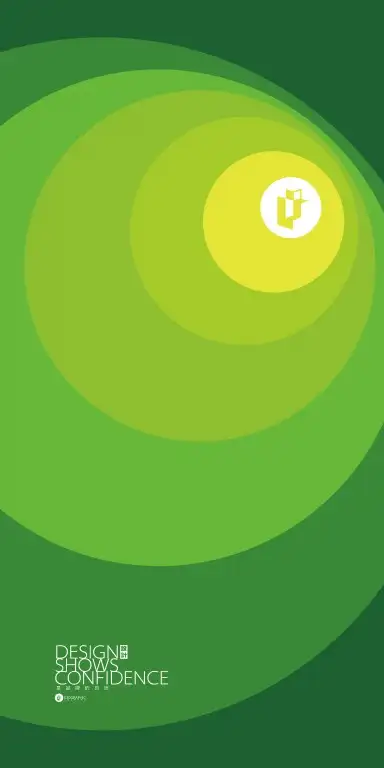
The 2014 office posters gave thought a landscape: a blue valley, a yellow summit and a green field of expanding circles. This independent study takes the first two off the wall and separates their colour bands into seven replaceable card profiles. The view changes when you do. For once, a change of perspective requires neither a meeting nor a new slide deck.
Follow the contours, not a convenient colour palette
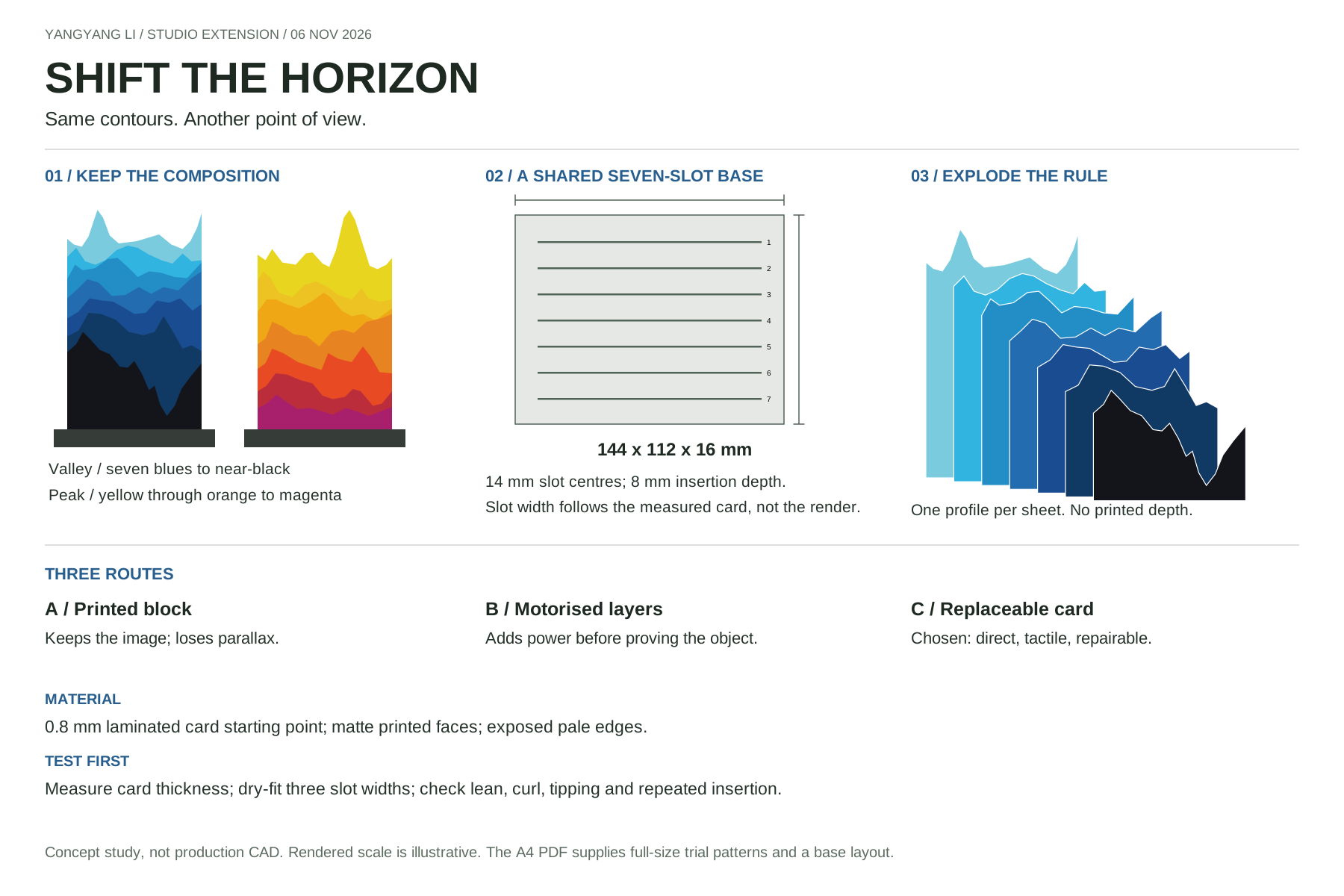
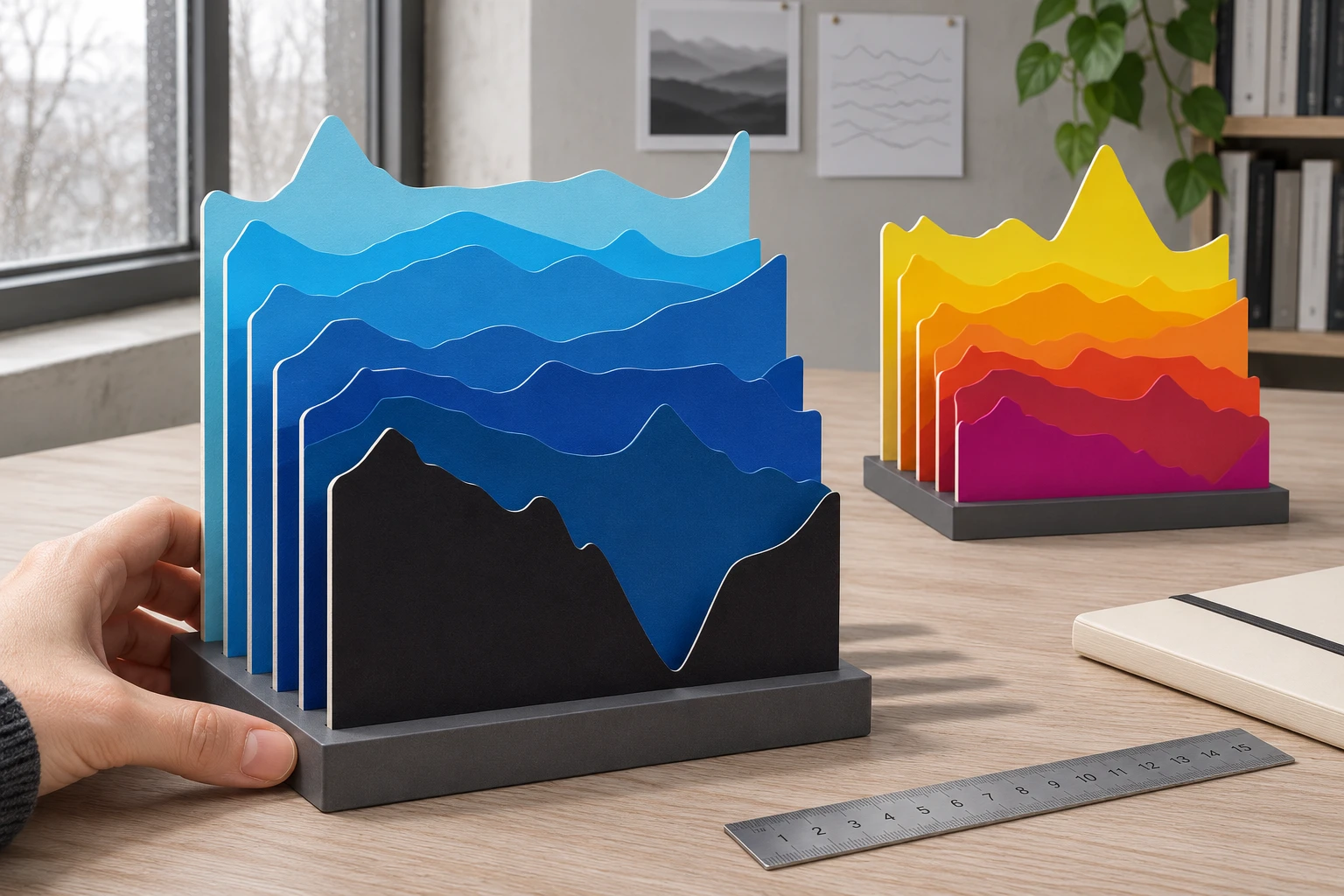
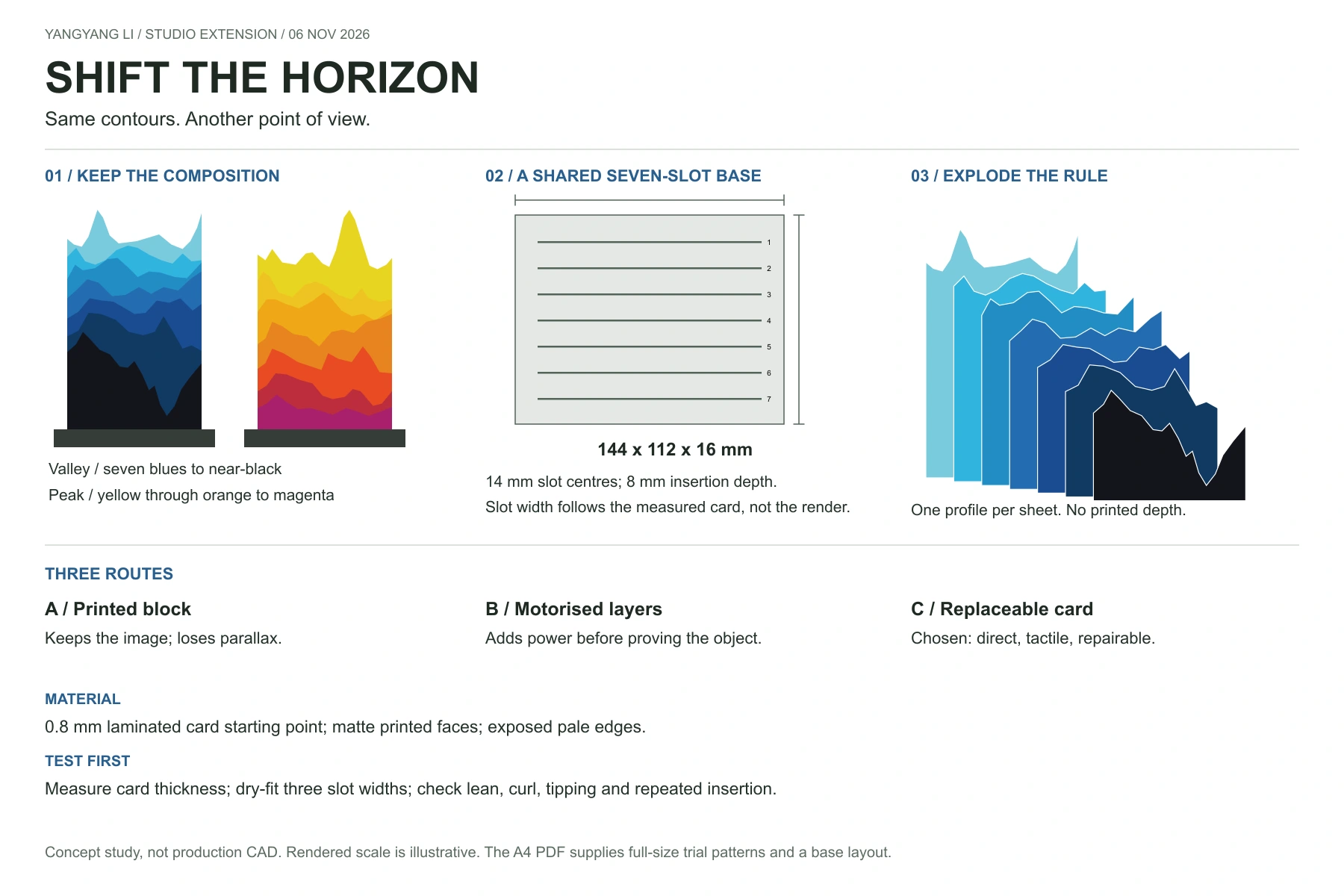
The blue source moves from cyan ridges into a deep, off-centre dark valley. Its warm companion leads the eye towards a yellow peak, with orange, red and magenta in front. Those silhouette relationships, flat colour fields and differences in apparent distance are the anchors. The downloadable profiles simplify the archived raster contours into cuttable polygons; they are a new interpretation, not recovered original vector paths. The portrait posters and the animated designer character remain part of the original series, but are not folded into this object just to make it busier.
A desk object for looking again
This is an adult creative-workspace object rather than a children's toy or a productivity tracker. A shallow seven-slot base holds the scene beside a notebook or on a studio shelf. Seen head-on, it returns to a graphic composition. From the side, the gaps reveal how that image is made. The owner can exchange the complete Valley and Peak sets, inspect one profile at a time and notice how foreground and background compete for attention. No screen, battery or performance score is needed.
Three routes; one useful restraint
A printed solid block would preserve the poster but remove the reason to move around it. Motorised layers would introduce power, drive parts and pinch points before the visual effect had earned them. Replaceable card makes the structure legible and lets a damaged or revised profile be remade without replacing the whole object. Both families use seven ordered profiles, the same 120 mm panel width and a shared base. Their contours differ; the connection rule does not.
Separate the material from the image of the material
The scene proposes matte printed faces, visible pale card edges and a quiet graphite base. Begin with paper laminated to card at roughly 0.8 mm total thickness, then measure the actual sample. The trial layout uses a 144 x 112 x 16 mm base, 14 mm slot centres and 8 mm insertion depth. A 1.0 mm slot width and 120.4 mm slot length are test values, not approved tolerances. The tallest assembled trial is approximately 204 mm including the base. The generated scene is an appearance proposal; the dimensioned patterns, not the apparent scale of the photograph, define the trial build.
Motion belongs to the layers
The browser study uses the same fourteen polygon profiles as the printable patterns. Viewpoint changes produce a small, depth-ordered horizontal offset; playback slowly crosses that range and can be paused or reset. It is a bounded graphic parallax experiment, not a 3D camera, a turntable render or a physical prediction of visibility. It starts still, remains manually adjustable and stops when the page is hidden. The original animated poster's time-and-money joke is left intact; this chapter explores a different part of the same series.
The next image should be a real sample
The 16-page A4 PDF contains a build guide, a full-size base layout and fourteen full-size cut patterns. Print at 100 percent and verify the 50 mm bars. Make a fit coupon using measured card thickness plus 0.1, 0.2 and 0.3 mm before committing to the base. Then check straight seating, panel curl, leaning, tip resistance, edge wear and repeated insertion. The base is a slotted test block or layered-board construction, not a paper net. No physical prototype, production tooling or certified toy safety is claimed.